Welcome to RTKSurvey.com

Manual vs Robotic Total Station: Key Differences and Applications
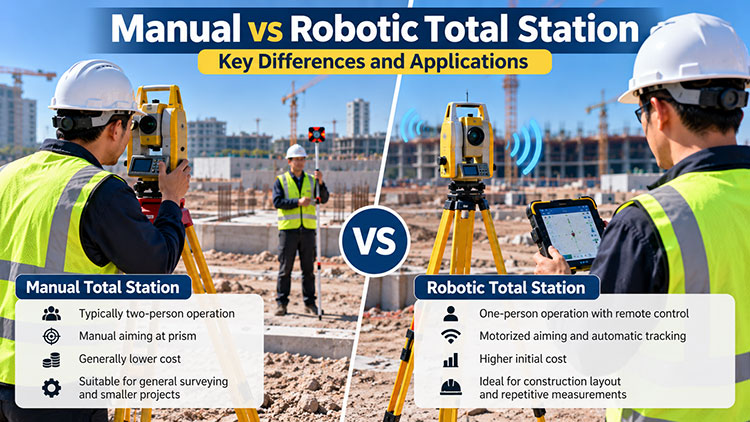
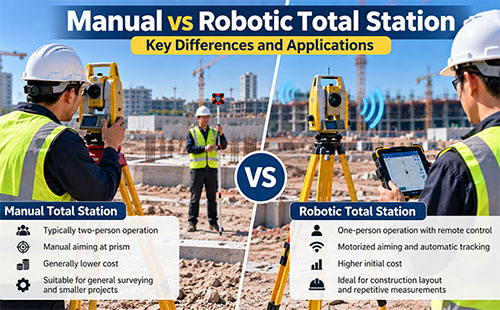
Manual and robotic total stations can both measure angles, distances and coordinates for professional surveying. However, they work differently in the field, especially when it comes to crew size, prism tracking and construction stakeout.
A robotic total station can allow one surveyor to operate from the prism pole, while a conventional manual total station generally requires someone at the instrument and another person at the target for prism-based work.
Does that mean a robotic total station is always the better investment? Not necessarily. The answer depends on your project workload, field conditions and equipment budget.
What Is a Manual Total Station?
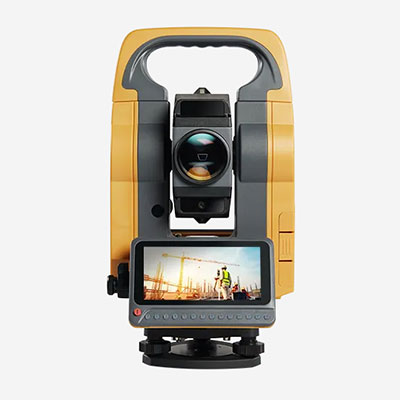
A manual total station is operated directly by a surveyor who aims the telescope at a prism or another suitable target, measures angles and distances, and records the results.
For conventional prism surveying, a typical crew includes an instrument operator and a second person carrying the prism pole.
Manual total stations remain useful for:
Boundary and topographic surveys
Building setting-out and construction checks
Small engineering projects
Occasional site measurements
Surveying teams working with limited equipment budgets
For example, the Topcon GM-52 and SOUTH NTS-332R10 are conventional total station options for general surveying work.
Manual operation does not mean low accuracy. Instrument specifications, calibration, observation procedures and field conditions determine measurement quality.
What Is a Robotic Total Station?
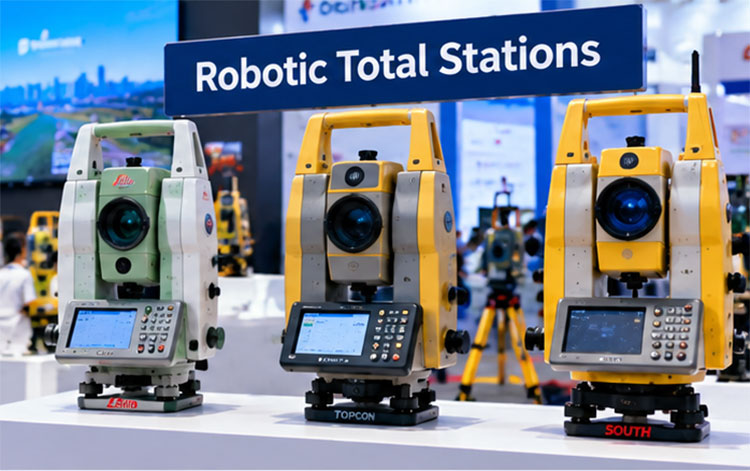
A robotic total station combines electronic angle and distance measurement with motorized movement, automatic target recognition and remote-control capabilities.
After the instrument is set up and oriented, a surveyor can operate a compatible robotic system from the prism pole using a field controller.
The instrument can automatically aim at and track a suitable prism, reducing the need for another person to remain at the total station.
Robotic systems are particularly useful for repetitive construction layout, high-volume detail surveys and projects where one-person field operation improves efficiency.
Examples available in the market include the Topcon GT-1200, SOUTH NS30 and FOIF RTS010A robotic total stations.
However, not every motorized total station supports the same automatic tracking functions. Buyers should confirm the exact model configuration, controller, software and prism requirements.
Manual vs Robotic Total Station: Key Differences
| Feature | Manual Total Station | Robotic Total Station |
|---|---|---|
| Typical prism survey crew | Two people | One person with a suitable system |
| Telescope aiming | Manual | Motorized and automated |
| Prism tracking | Operator re-aims | Automatic tracking on supported models |
| Remote operation | Generally limited | Supported with compatible controller |
| Repetitive stakeout | Requires crew coordination | Surveyor receives guidance at the pole |
| Initial equipment cost | Generally lower | Generally higher |
| Setup and training | Often simpler | More system components to configure |
| Best fit | General surveying and smaller workloads | Frequent layout and repetitive measurements |
Both types still require correct station setup, control verification, instrument checks and suitable survey procedures.
Case 1: Setting Out 120 Foundation Points
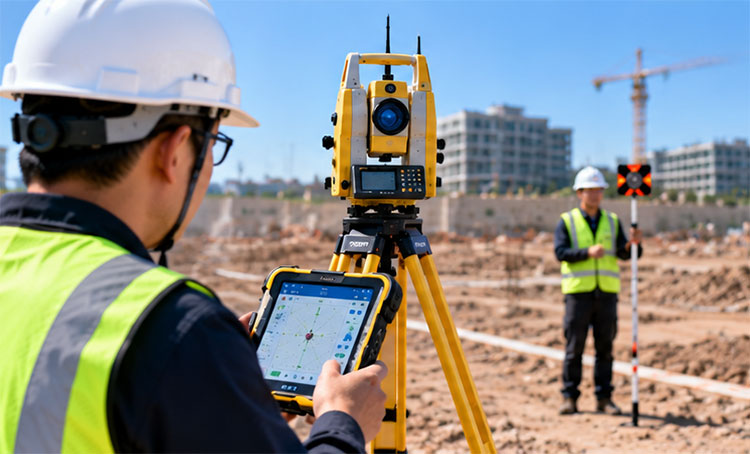
Illustrative construction scenario, not a documented customer project.
A construction contractor needs to set out 120 foundation points across a building site.
Using a Manual Total Station
One surveyor operates the instrument while another carries the prism pole.
At each point, the instrument operator aims at the prism, measures its position and communicates the required movement to the pole operator.
This workflow is effective, but repeated communication and manual aiming can become time-consuming when many points must be marked.
Using a Robotic Total Station
With a compatible robotic system, one surveyor can carry the prism pole and controller.
The instrument tracks the prism while the controller displays the required movement toward each design point.
The surveyor can move, check the position and mark the point without continually communicating with an instrument operator.
Practical takeaway: Robotic operation can reduce staffing requirements and improve workflow efficiency on repetitive layout tasks.
However, actual time savings depend on target visibility, tracking reliability, site obstructions and the operator's experience. A robotic instrument cannot eliminate all field delays.
Case 2: A Small Surveying Company Handles Occasional Site Work
Illustrative purchasing scenario.
A small surveying company completes boundary-related measurements, topographic surveys and occasional building stakeout.
Its field team normally consists of two surveyors, and total station work occupies only a few days each month.
The company is considering replacing its manual total station with a robotic model.
Before investing, it reviews three questions:
How frequently will one-person operation be useful?
If both surveyors are usually required on site for other tasks, robotic operation may not produce a major reduction in labor requirements.
Will the instrument be used for repetitive stakeout?
A few measurements per day may not justify the additional cost of robotic tracking and remote-control equipment.
What is the complete purchase cost?
The company needs to consider the controller, compatible prism, software, batteries and support arrangements, not just the instrument price.
For this company, a reliable manual total station may remain the more economical choice.
Practical takeaway: The best equipment is not necessarily the most automated. It is the instrument that matches the company's actual workload.
Does a Robotic Total Station Have Better Accuracy?
Not automatically.
Both manual and robotic total stations are available with different angular and distance accuracy specifications.
A robotic instrument may reduce variation associated with repeated manual aiming by using automatic target recognition, but it does not remove other sources of surveying error.
These include:
Incorrect instrument or prism centering
Wrong prism constant
Poor station orientation
Incorrect instrument or target height
Unstable control points
Atmospheric and measurement conditions
For example, if a robotic total station is oriented using an incorrect backsight coordinate, its automated measurements may still produce systematically incorrect positions.
Automation improves how measurements are performed; it does not replace survey control and quality checks.
For a broader explanation of instrument specifications, see our How to Choose a Total Station guide.
When Is a Robotic Total Station Worth the Investment?
Robotic equipment is most attractive when it produces meaningful savings across repeated projects.
Consider a simplified example.
A contractor estimates that one-person robotic operation could save 2.5 crew-hours per working day compared with its current two-person workflow.
If that saving occurs on 100 working days, the potential reduction is:
2.5 hours × 100 days = 250 crew-hours
This is an illustrative calculation, not a guaranteed productivity result.
The financial benefit depends on actual labor costs, instrument utilization, site conditions and whether the second crew member can be reassigned to productive work.
Buyers should also consider additional equipment costs, maintenance, training and possible interruptions when automatic prism tracking is lost.
For occasional surveying, a manual total station may offer better overall value. For frequent construction stakeout, robotic operation may justify its higher initial cost.
What Should You Check Before Buying?
Whether purchasing a manual or robotic total station, confirm the equipment package rather than comparing instrument names alone.
For robotic systems, pay particular attention to:
Automatic target recognition and tracking functions
Remote controller and communication compatibility
Supported prism types, including 360-degree prisms where applicable
Stakeout and data collection software
Angular and distance measurement specifications
Battery capacity and charging arrangements
Warranty and technical support
A robotic total station is a complete working system. Missing software functions or incompatible accessories can limit the benefits of its automation.
Explore the Total Stations available from RTKSurvey.com to compare manual and robotic models.
Frequently Asked Questions
Can one person operate a robotic total station?
Yes. A properly configured robotic total station can support one-person surveying and stakeout using remote control and automatic prism tracking. Certain tasks or site conditions may still require additional personnel.
Is a robotic total station more accurate than a manual total station?
Not necessarily. Accuracy depends on the instrument specifications and survey procedures. Robotic tracking can reduce manual aiming work, but it does not automatically guarantee better coordinates.
Can a robotic total station work without a prism?
Many robotic models also offer reflectorless measurements, but the available functions depend on the instrument. Automatic prism tracking and reflectorless distance measurement are different capabilities.
Is a manual total station still worth buying?
Yes. Manual total stations remain practical for general surveying, smaller projects and teams that do not need frequent one-person stakeout.
Which is better for construction stakeout?
Robotic total stations are often advantageous for repetitive layout involving many points. Manual models can still be suitable for smaller jobs, particularly where two-person crews are already available.
Choose the Right Total Station for Your Projects
The main difference between manual and robotic total stations is not simply measurement accuracy. It is how the instrument fits into the surveying workflow.
Manual total stations offer straightforward operation and generally lower purchase costs. Robotic systems add automatic tracking and remote operation that can improve efficiency on suitable projects.
RTKSurvey.com is a China-based surveying equipment supplier offering total stations from multiple brands for international professional buyers.
Browse our Total Stations or contact RTKSurvey.com to discuss instrument options, configurations and purchasing requirements.