Welcome to RTKSurvey.com

Reflectorless Total Station vs Prism: Which Is More Accurate?
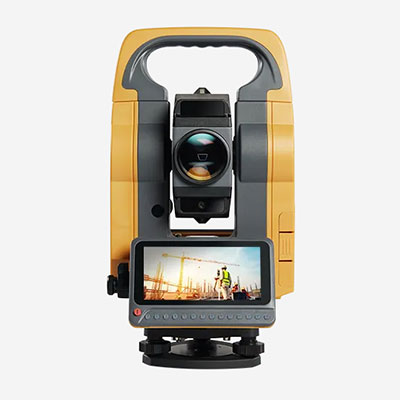
A modern total station can often measure distances in two ways: to a survey prism or directly to a surface without a reflector.
Reflectorless measurement is convenient for building facades, elevated structures and inaccessible points. Prism measurement remains widely used for construction layout, control surveys and precise positioning.
But which method is more accurate, and when should surveyors choose one over the other?
The answer depends on the instrument's EDM specifications, target conditions and the accuracy required for the job.
Quick Answer: Is Prism Measurement More Accurate?
Prism measurement generally provides more predictable results for precision surveying, especially when the target is properly centered and the correct prism constant is used.
Reflectorless measurement can also achieve millimeter-level distance precision under suitable conditions, but its performance is more sensitive to surface reflectivity, beam angle, target size and measurement distance.
The correct comparison is between the prism and reflectorless specifications of the exact total station model, not a universal accuracy figure.
How Prism Measurement Works
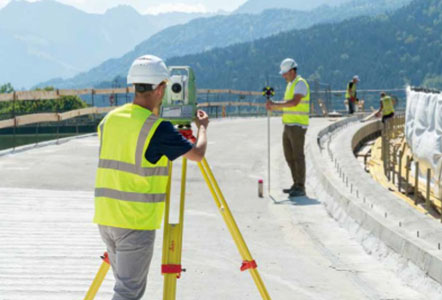
In prism mode, the total station transmits an electronic distance measurement (EDM) signal toward a reflector.
The prism returns the signal, allowing the instrument to calculate the distance. Combined with horizontal and vertical angle observations, the instrument can determine the target position.
A prism provides a defined measurement target, making this method useful for:
Survey control and traverse measurements
Construction stakeout
Building grid and foundation layout
Topographic surveying
Monitoring points with installed reflectors
However, accurate results require more than a good EDM specification.
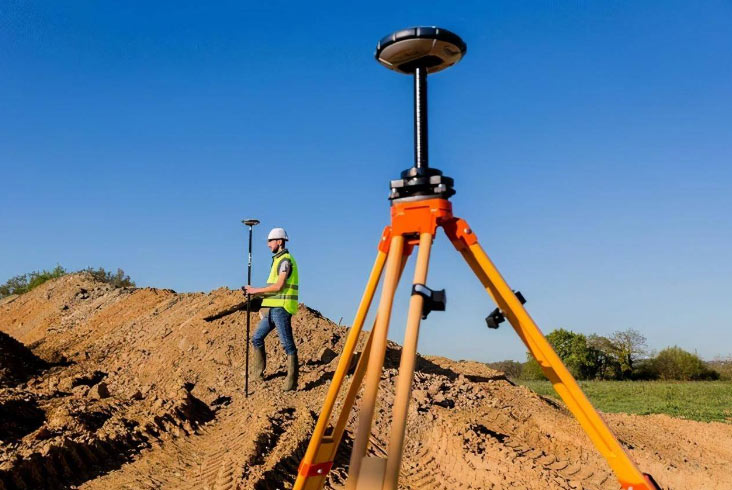
Prism centering, pole verticality, target condition and the correct prism constant all matter.
Explore our Surveying Prisms for different prism configurations used in professional surveying.
How Reflectorless Measurement Works
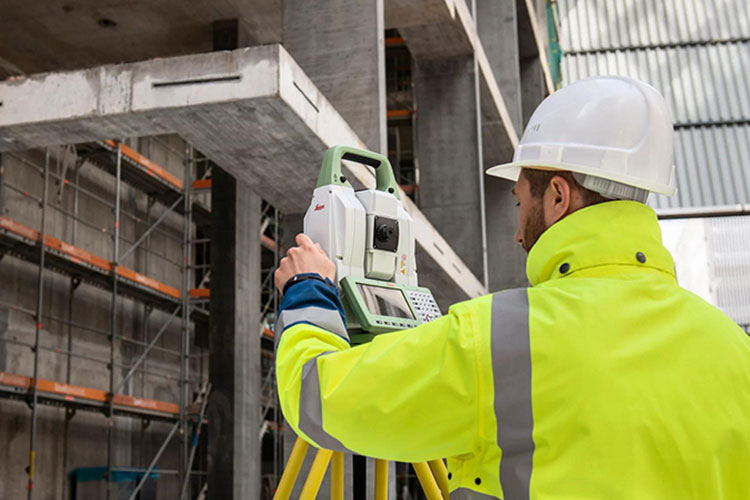
In reflectorless mode, the total station measures directly to a surface without requiring a survey prism at the target point.
The EDM signal is reflected by the material itself, such as concrete, brick, metal or rock.
This method is useful when the target is difficult or unsafe to reach.
Typical applications include:
Building facade measurements
Overhead beams and structural features
Rock faces and excavations
Existing-condition surveys
Selected construction measurements
Reflectorless operation eliminates the need to place a prism at every measured location.
However, the returned signal depends on the target surface, so the instrument may not perform equally well on every material.
Reflectorless vs Prism: Key Differences
| Factor | Prism Measurement | Reflectorless Measurement |
|---|---|---|
| Target | Survey prism | Existing surface |
| Typical precision | Often more predictable | More surface-dependent |
| Measuring range | Often longer | Depends strongly on surface and instrument |
| Target access | Prism must be positioned | No physical target placement required |
| Main error risks | Prism constant, centering, pole tilt | Surface reflection, incidence angle, beam footprint |
| Common applications | Control, stakeout, traverse | Facades, inaccessible structures |
| Best selection method | Check prism EDM specification | Check reflectorless EDM specification and target conditions |
Understanding EDM Accuracy: What Does mm + ppm Mean?
Total station distance accuracy is commonly expressed as a fixed component plus a distance-dependent component.
For example, an EDM specification might state:
2 mm + 2 ppm
The fixed component is 2 mm, while 2 ppm corresponds to 2 mm per kilometer.
At a measured distance of 200 meters:
2 ppm × 200 m = 0.4 mm
The specification therefore gives a nominal distance-accuracy expression of:
2 mm + 0.4 mm = 2.4 mm
This is an illustrative calculation, not a guarantee that every observation will fall within ±2.4 mm. Manufacturer accuracy expressions depend on stated test conditions and statistical definitions.
Prism and reflectorless modes may have different EDM specifications even on the same instrument.
Also remember that EDM accuracy is not the same as total point-position accuracy. Angular observations, setup quality and target geometry contribute additional uncertainty.
Why Reflectorless Measurements Can Be Less Reliable
1. Surface Reflectivity
A light-colored, smooth surface may return a stronger signal than a dark or poorly reflective surface.
Wet, rough or irregular materials can change the reflected signal and reduce usable range.
Published reflectorless ranges may be based on standardized test targets rather than typical construction materials.
2. Angle of Incidence
When the laser strikes a surface at a shallow angle, its footprint becomes elongated.
The returned signal may represent a less clearly defined area than when the beam strikes approximately perpendicular to the surface.
For critical points, consider whether the measured location corresponds to the intended physical feature.
3. Edges and Small Targets
Reflectorless measurements near an edge can be misleading.
If the laser footprint overlaps a wall edge, pipe or narrow structural member, part of the signal may come from the background.
The resulting distance may not represent the intended point.
Moving the aim slightly or repeating the observation from another station can help identify questionable results.
4. Measurement Distance
The laser footprint generally increases with distance.
A surface that is easy to measure at 20 meters may become more difficult at 200 meters, particularly when the target is small or poorly reflective.
Always compare actual working distances with the manufacturer's specified conditions.
Field Example: Measuring a Building Facade
Consider a construction survey requiring measurements of a building facade and several foundation control points.
The facade includes upper-floor corners that cannot be safely reached with a prism pole.
Reflectorless mode may be suitable for observing accessible wall surfaces and clearly defined structural features from a safe position.
However, the foundation control points require repeatable measurements to defined physical locations.
For those observations, a properly centered prism may be the better choice.
The surveyor can use both methods during the same project while applying different quality checks according to the required tolerances.
This is an illustrative field scenario rather than a documented project result.
How to Check Reflectorless Accuracy in the Field
For work where reflectorless observations affect critical dimensions, use a practical verification procedure:
Check the total station's calibration and setup condition.
Select a stable, clearly defined test surface.
Measure a suitable reference distance using a verified prism setup.
Observe the comparable surface or reference target in reflectorless mode.
Repeat measurements and check their consistency.
Investigate differences that exceed the project's acceptable tolerance.
The prism and reflectorless measurements must refer to the same physical geometry, with any target offsets accounted for. Otherwise, their difference cannot be interpreted as an EDM error.
A controlled test does not prove that every other surface will behave identically, but it can help identify equipment or setup problems.
For a broader discussion of angular and distance specifications, read Total Station Accuracy Explained.
What to Check Before Buying a Reflectorless Total Station
Before comparing total station models, review these specifications:
| Specification | Buying Consideration |
|---|---|
| Prism EDM accuracy | Important for control and stakeout |
| Reflectorless EDM accuracy | Important for direct surface measurement |
| Reflectorless range | Check test target and atmospheric conditions |
| Angular accuracy | Affects point positioning, especially at longer distances |
| Laser spot size | Important for small targets and edges |
| Prism compatibility | Check reflector types and constants |
| Measurement software | Confirm required survey functions |
| Service and calibration | Consider long-term instrument maintenance |
A longer advertised reflectorless range does not automatically make one total station better for your project.
For example, a construction team working mainly within 100 meters may benefit more from dependable measurements on common building materials than from an unusually long maximum range.
Browse our Total Stations to compare available equipment options.
Frequently Asked Questions
Can a reflectorless total station measure through glass?
Not reliably. Glass can reflect, transmit or refract the measurement beam. The returned distance may not correspond to the intended surface.
Is reflectorless measurement suitable for control surveys?
It depends on the required accuracy and the measurement conditions. For high-precision control, prism-based observations are generally preferable because they provide a defined target and more controllable measurement geometry.
Does a 1-second total station always measure distance more accurately than a 2-second model?
No. The 1-second and 2-second values describe angular accuracy classes, not EDM distance accuracy. Both specifications must be checked separately.
Final Thoughts
Prism and reflectorless measurements are complementary capabilities rather than competing solutions.
Prism measurement is usually the preferred choice when surveyors can establish a stable target and need highly repeatable observations.
Reflectorless measurement is valuable when points are inaccessible, elevated or unsafe to occupy, provided that the surface and accuracy requirements are suitable.
The best surveying workflow often uses both methods.
RTKSurvey.com supplies professional Total Stations and Surveying Prisms from multiple brands for international surveying and engineering customers.