Welcome to RTKSurvey.com

Total Station Accuracy Explained: 1", 2" and 5" Models
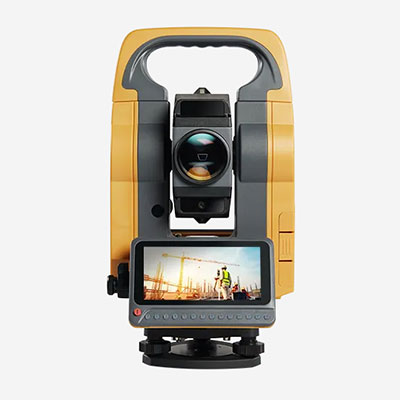
When comparing total stations, buyers often see models described as 1-second, 2-second or 5-second instruments. These numbers refer to angular measurement accuracy, but they do not describe the complete accuracy of a surveying project.
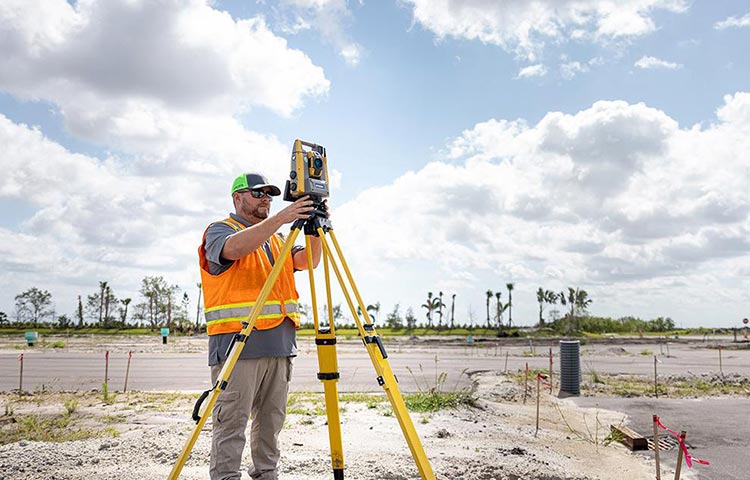
A 1" total station is not automatically the best choice for every survey, and a 5" instrument is not necessarily unsuitable for construction work. The correct choice depends on measurement distance, required tolerances, survey procedures and the instrument's distance measurement performance.
This guide explains total station accuracy specifications, the practical differences between 1", 2" and 5" models, and what surveying companies should check before purchasing equipment.
1. What Does Total Station Accuracy Mean?
A total station measures horizontal angles, vertical angles and distances to calculate the position of surveyed points.
Its accuracy is influenced by several factors, including angular measurement, electronic distance measurement (EDM), instrument setup and environmental conditions.
Manufacturers commonly publish separate specifications for:
Angular accuracy: The precision of horizontal and vertical angle measurements.
Distance accuracy: The accuracy of measurements made by the EDM system.
Compensator performance: The instrument's ability to detect and compensate for small leveling errors within its operating range.
Reflectorless measurement performance: The distance measurement capabilities and limitations when measuring without a prism.
These specifications should be considered together rather than relying on a single headline number.
2. What Do 1", 2" and 5" Mean on a Total Station?
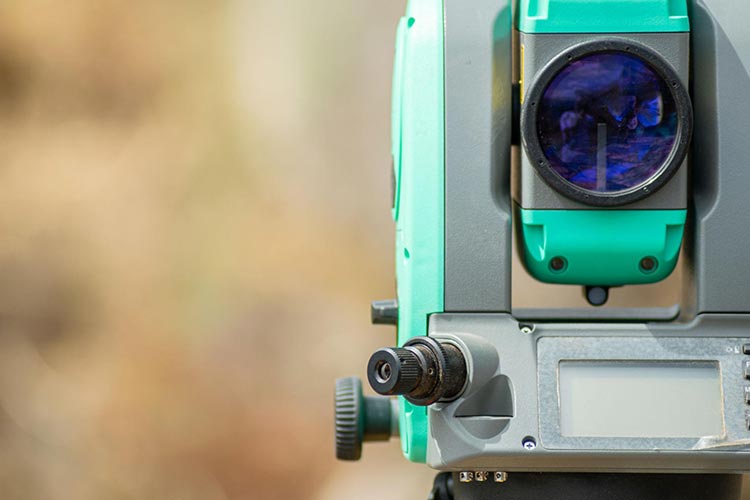
The symbols 1", 2" and 5" refer to arc-seconds, which are units of angular measurement.
One degree contains 60 arc-minutes, and one arc-minute contains 60 arc-seconds.
Therefore:
1" equals 1/3,600 of a degree.
2" equals 2/3,600 of a degree.
5" equals 5/3,600 of a degree.
A smaller angular accuracy value generally indicates a higher specified level of angular measurement performance, assuming the specifications are based on comparable testing standards.
For example, a 1" total station is generally designed for more demanding angular measurements than a 5" model.
However, the published angular accuracy is not a guarantee that every individual measurement will differ from its true value by no more than that amount.
How Angular Accuracy Affects Point Position
Angular measurement uncertainty can produce a larger lateral position uncertainty as the distance to the measured point increases.
For small angles, the approximate lateral displacement associated with a given angular difference can be estimated using:
Lateral displacement ≈ Distance × Angle (in radians)
The following table illustrates the approximate lateral displacement corresponding to angular differences of 1", 2" and 5".
| Distance | 1" Angular Difference | 2" Angular Difference | 5" Angular Difference |
|---|---|---|---|
| 50 m | 0.24 mm | 0.48 mm | 1.21 mm |
| 100 m | 0.48 mm | 0.97 mm | 2.42 mm |
| 200 m | 0.97 mm | 1.94 mm | 4.85 mm |
| 500 m | 2.42 mm | 4.85 mm | 12.12 mm |
Note: These are theoretical geometric illustrations, not guaranteed instrument accuracy values or complete survey uncertainty estimates. They exclude distance measurement uncertainty, setup errors, target errors and other field influences.
This comparison demonstrates why angular measurement performance becomes increasingly important for longer sight distances and demanding positioning work.
3. Is a 1-Second Total Station More Accurate Than a 2-Second Model?
When angular accuracy specifications are measured under comparable conditions, a 1" model has a tighter published angular accuracy specification than a 2" model.
This can be beneficial for applications involving precise angle measurement, demanding control networks or longer sight distances.
However, overall survey performance depends on more than angular accuracy.
For example, a well-maintained 2" total station operated with careful centering, stable targets and appropriate measurement procedures may produce better field results than a poorly set up 1" instrument.
When a 1" Total Station May Be Appropriate
A 1" instrument may be worth considering for:
High-precision engineering surveys
Demanding control network measurements
Precise industrial or structural measurement tasks
Projects involving long sight distances and strict angular requirements
The required specification should always be determined from the project's measurement tolerance and uncertainty requirements.
When a 2" Total Station Is a Practical Choice
A 2" total station can be a suitable option for many professional surveying and engineering applications.
It may offer an effective balance between angular measurement performance, instrument features and purchasing cost.
Typical applications include construction control, topographic surveys, engineering layout and general surveying work where the required accuracy is achievable with the complete measurement procedure.
4. Is a 5-Second Total Station Accurate Enough for Construction?
A 5" total station can be suitable for many routine construction and surveying tasks.
However, suitability depends on the required tolerance, observation distance, control quality and measurement method.
Potential applications include:
General construction layout
Routine topographic point collection
Site measurement and verification
Basic engineering surveys
Projects with moderate angular accuracy requirements
For tasks requiring tighter tolerances or more demanding control measurements, a 2" or 1" model may be preferable.
The important question is not simply whether a 5" total station is accurate enough for construction in general.
It is whether the instrument and survey procedure can meet the specific accuracy requirements of the project.
5. Angular Accuracy vs EDM Distance Accuracy
Angular accuracy and distance accuracy are different specifications.
A total station can have a high angular accuracy rating while its EDM performance follows a separate accuracy specification.
Distance measurement accuracy is often expressed in a format such as:
±(2 mm + 2 ppm × D)
Here, D represents the measured distance, and ppm means parts per million.
This is an illustrative specification format, not a universal value for all total stations.
For an instrument with this example specification, the distance-dependent component increases with measurement distance.
| Measured Distance | Example EDM Accuracy Expression |
|---|---|
| 100 m | ±2.2 mm |
| 500 m | ±3.0 mm |
| 1,000 m | ±4.0 mm |
These values illustrate how the stated formula works. They do not account for every field error or represent a guarantee of actual measurement results.
When comparing instruments, check whether the published EDM specification applies to prism measurements, reflectorless measurements or a particular measurement mode.
Different modes may have different accuracy and range specifications.
6. Prism and Reflectorless Measurement Accuracy
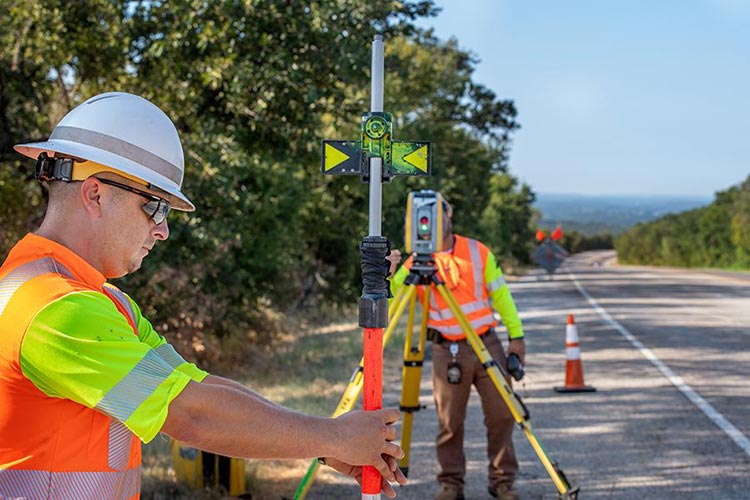
Many modern total stations support both prism and reflectorless distance measurement.
Prism Measurement
Prism measurement uses a reflector to return the EDM signal to the instrument.
It is commonly used for control surveys, construction layout and other applications where the surveyor can position a target at the required point.
Important considerations include prism constant settings, target centering, reflector condition and compatibility with the instrument.
An incorrect prism constant can introduce systematic distance errors.
For additional guidance, read our Total Station Prism Compatibility Guide.
Reflectorless Measurement
Reflectorless measurement allows distances to be measured without placing a prism at the target.
This can be useful for inaccessible building surfaces, structural features and certain site measurements.
However, reflectorless accuracy depends on the instrument's EDM specification and the characteristics of the measured surface.
Target reflectivity, surface angle, beam footprint and environmental conditions can affect measurement quality.
A long advertised reflectorless range should not be confused with guaranteed accuracy at every distance.
7. Other Factors That Affect Total Station Accuracy
Even a high-precision total station can produce poor results if field procedures are incorrect.
Instrument Centering and Leveling
Errors in centering the instrument over a control point can affect measured directions and calculated positions.
Careful setup and verification are essential, especially for demanding control work.
Prism Pole and Target Setup
A prism pole that is not properly vertical can introduce position errors.
Target height, prism constant and target stability should also be checked before measurement.
Atmospheric Conditions
Temperature, atmospheric pressure and other environmental conditions influence electronic distance measurement.
Appropriate atmospheric corrections should be applied according to the instrument manufacturer's instructions and project requirements.
Calibration and Instrument Condition
Regular inspection, adjustment and appropriate calibration help maintain instrument performance.
A total station that has experienced an impact or shows inconsistent results should be checked before being used for critical work.
Observation Procedures
Repeated observations, face-left and face-right measurements, suitable control geometry and independent checks can improve measurement reliability.
For demanding surveys, a proper uncertainty assessment and measurement procedure are more important than choosing equipment based on a single specification.
8. Which Total Station Accuracy Should You Choose?
The following examples show how instrument selection can differ by application. They are illustrative scenarios, not reports of completed customer projects.
Example A: General Construction Contractor
A contractor needs a total station for routine layout, site checks and basic topographic measurements.
Selection approach: Compare 2" and 5" models against the project's required tolerances, typical sight distances, EDM specifications and available software functions.
A 1" instrument may not provide meaningful additional value if the project does not require tighter angular measurement performance.
Example B: Engineering Survey Company
An engineering survey company performs control measurements and precise layout on projects with stricter tolerances.
Selection approach: Evaluate 1" and 2" instruments, together with EDM performance, compensator specifications, calibration support and measurement procedures.
The final choice should be based on the project's accuracy requirements rather than the angular rating alone.
Example C: Surveying Equipment Distributor
A distributor wants to offer total stations for different customer groups.
Selection approach: Maintain a practical selection of angular accuracy classes and explain their intended applications.
Providing clear information about EDM performance, reflectorless functions, software compatibility and accessories can help customers select the right configuration.
9. What to Check Before Buying a Total Station
Before comparing quotations, confirm the following information:
Angular accuracy: Verify whether the instrument is rated at 1", 2", 5" or another accuracy class, and check the applicable test standard.
EDM accuracy: Compare prism and reflectorless distance measurement specifications separately.
Measurement range: Check practical working distances for the intended targets and field conditions.
Compensator: Review the compensator type, operating range and relevant specifications.
Field software: Confirm the required survey, coordinate and stakeout functions.
Accessories: Verify prisms, tripods, batteries, chargers and data transfer equipment.
Service support: Check warranty coverage, calibration arrangements and technical assistance.
A complete purchasing decision should consider both measurement performance and the equipment's suitability for daily field operations.
For broader purchasing guidance, read our How to Choose a Total Station article.
Frequently Asked Questions
What Does 2" Accuracy Mean on a Total Station?
A 2" rating refers to the instrument's published angular measurement accuracy, expressed in arc-seconds. It does not mean the total station always measures point coordinates within a fixed 2 mm tolerance.
Is a 1" Total Station Always Better Than a 5" Model?
A 1" instrument generally has a tighter angular accuracy specification, but the better choice depends on project requirements, measurement distance, EDM performance and budget.
How Accurate Is a Total Station at 100 Meters?
There is no single answer for every instrument. Accuracy depends on angular measurement, EDM specifications, instrument setup, target positioning and observation conditions.
Does a Higher Angular Accuracy Rating Improve Distance Measurement?
Not directly. Angular accuracy and EDM distance accuracy are separate instrument specifications.
Can a 5" Total Station Be Used for Construction Stakeout?
Yes, for projects where the complete measurement system and field procedure meet the required tolerances. More demanding applications may require a tighter angular accuracy specification.
Is Prism Measurement More Accurate Than Reflectorless Measurement?
Many total stations publish different accuracy specifications for prism and reflectorless modes. Buyers should compare the actual specifications of the intended instrument and measurement mode.
Compare Total Stations for Your Surveying Projects
Choosing a total station involves more than comparing 1", 2" and 5" angular accuracy ratings.
The right instrument should meet your project's accuracy requirements while providing suitable EDM performance, surveying functions, accessories and service support.
RTKSurvey.com is a multi-brand surveying equipment supplier offering total stations and related accessories for international buyers.
Explore our Total Stations category to review available brands and models.
If you are sourcing equipment for construction, engineering surveying or distribution, contact RTKSurvey.com with your application, required accuracy class and destination country to discuss suitable configurations.