Welcome to RTKSurvey.com

Total Station Prism Compatibility: What to Check Before Ordering
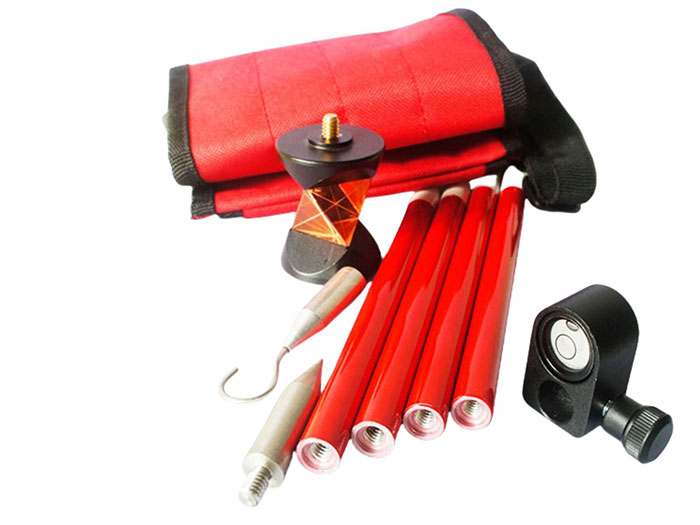
A replacement prism can look almost identical to the one already in a surveyor's equipment case. The thread fits, the target is clearly visible through the telescope, and the total station measures a distance without reporting an error.
That does not necessarily mean the replacement is ready for fieldwork.
A different prism constant can introduce a systematic distance error. A new holder can change the relationship between the pole tip and the reflector center. A 360-degree prism may return a measurement while offering different tracking performance from the target it replaced.
These are separate compatibility issues, and they are not always obvious from a product photograph.
For contractors replacing damaged equipment and dealers supplying prisms for different total station brands, the most useful question is not simply whether a prism fits. It is whether the complete reflector setup will work correctly with the instrument, controller and measurement method.
Why Total Station Prism Compatibility Matters
A total station measures angles and distances to a target. When that target is a prism, the instrument or field software must account for the reflector's characteristics to calculate the intended measurement.
The prism is only one part of the setup. Its holder, mounting connection, target height and software configuration also matter.
A replacement can therefore be compatible in one respect and unsuitable in another.
For example, a standard prism might work for manual observations but not support the tracking functions required by a robotic survey crew. Two reflectors may use similar holders while requiring different distance corrections.
This distinction becomes particularly important when equipment is shared between crews or when a dealer supplies replacement accessories for several instrument brands.
Case 1: A Replacement Prism Creates a Distance Difference

Consider a construction survey crew replacing a damaged prism assembly during a project.
The original reflector is no longer available, so the team purchases a visually similar replacement. The new assembly fits the existing pole, and the total station measures normally.
However, a check against a known baseline reveals a consistent difference between observations made with the original target configuration and the replacement.
One possible cause is an incorrect prism constant.
What the Prism Constant Actually Changes
A prism constant is associated with the correction required for the reflector's optical geometry. The total station or field software uses the relevant setting when processing the measured distance.
If the replacement reflector requires a different correction and the instrument continues using the previous setting, the resulting distances may be systematically wrong.
This is not the same as random measurement noise. Repeated observations can be consistent while still carrying the wrong correction.
The problem is also easy to overlook because the instrument may not display a warning.
Why 0 mm, -30 mm and Other Values Need Context
Surveyors frequently encounter prism constants expressed in millimeters. Values such as 0 mm and -30 mm appear in equipment specifications, but the meaning of a published number depends on the manufacturer's reference convention.
The same reflector may be described using different offset conventions. A value that is correct in one manufacturer's documentation should not automatically be entered into another instrument.
There is a second complication: some field software applies the prism correction itself, while certain instrument-and-software combinations may require the operator to check where the correction is being applied.
Applying a correction twice can be just as problematic as failing to apply it.
For a replacement prism, the reliable approach is to identify the exact reflector model, obtain its documented correction information and confirm the target setting used by the total station or controller.
How to Investigate a Suspected Prism Constant Error
Start with a known control distance or another suitable reference measurement.
Check the current target definition and the correction shown in the instrument or field software. Compare these settings with the documentation for the actual prism.
If a previous reflector is available, make a controlled comparison without changing other measurement variables.
Do not simply adjust the prism constant until the result looks correct. A distance discrepancy can also arise from atmospheric settings, centering, instrument calibration or other measurement errors.
The purchasing lesson: when replacing a prism, request its documented correction information rather than relying only on the product's appearance or mounting dimensions.
Case 2: A 360-Degree Prism Measures Distance but Does Not Track Reliably
A contractor using a robotic total station wants to replace an expensive or damaged 360-degree reflector.
A lower-cost alternative appears suitable: it has a multi-directional reflective design and mounts onto the existing pole.
During a static test, the total station successfully measures the target. But when the pole operator walks around the site, the instrument loses tracking more often than expected.
Does this mean the prism is incompatible?
Not necessarily. It means that basic distance measurement has been demonstrated, while the required tracking performance has not.
Reflector Geometry Is Only Part of Robotic Compatibility
A 360-degree prism is designed to provide reflective surfaces over a wide range of horizontal directions. This can reduce the need to manually orient a conventional prism toward the instrument.
Robotic total stations, however, may also use automatic target recognition, target identification or other tracking functions.
Some systems support specialized active targets or selectable tracking modes. These capabilities cannot be assumed from the presence of a 360-degree reflector alone.
The total station model, target design and controller configuration must be considered together.
What to Test Before Ordering Multiple Units
For a contractor buying a single replacement, a model-specific compatibility confirmation may be sufficient to narrow the options.
For a dealer purchasing a batch of robotic prisms, testing one representative assembly with the intended instrument is a stronger approach when practical.
A useful trial should go beyond a single stationary distance observation.
Check whether the instrument can acquire the target, maintain tracking as the operator changes direction and recover after a temporary obstruction.
Also check the behavior in an environment with reflective machinery, glass or multiple survey targets, where the instrument may have more difficulty maintaining the intended lock.
If the robotic system uses target identification or active tracking technology, confirm whether those features are supported by the proposed replacement.
The purchasing lesson: a prism advertised as suitable for robotic surveying should be evaluated against the exact robotic total station and the functions the crew actually uses.
Case 3: A New Prism Holder Changes the Target Height
Not every prism-related measurement problem involves the prism constant.
Consider a survey crew using a mini prism for construction layout around steel columns.
The original reflector holder is damaged. A replacement holder is purchased with a matching thread, and the prism is installed on the same pole.
The operator continues entering the target height used with the previous assembly.
The horizontal measurements appear reasonable, but elevation checks reveal a discrepancy.
One possible explanation is that the replacement holder places the prism center at a different position relative to the mounting reference.
Prism Height and Prism Constant Are Different
The prism constant concerns distance correction associated with the reflector.
Target height concerns the position of the reflector center relative to the surveyed point.
Changing a holder, adapter or mounting assembly can affect that relationship, even if the reflector itself has not changed.
Some systems also support particular target-height measurement methods, such as measuring to a reference mark on a prism base and applying a known geometric offset.
Those methods depend on using the correct target assembly and software configuration.
Why Mounting Compatibility Needs More Attention
A threaded connection only establishes that two components can be joined mechanically.
It does not establish that the reflector center is positioned at the same height or that the assembly has the same centering geometry.
This matters when purchasing replacement mini prism sets, traverse assemblies, tribrach adapters and monitoring mounts.
Before ordering, determine whether the requirement is for the glass reflector alone, the prism with its holder, or a complete assembly with target plate and mounting hardware.
If the original assembly is available, compare the relevant dimensions and reference points rather than relying on a visual match.
The purchasing lesson: when replacing a complete prism assembly, check the geometry of the holder and adapter as carefully as the reflector specification.
Choosing a Prism for the Way the Total Station Is Used
The right reflector depends partly on the measurement task.
Manual Total Station Surveying
For conventional manual observations, a standard circular prism is often a practical option.
The operator can orient the reflector toward the instrument, and the setup can be selected according to the required working distance, accuracy and mounting arrangement.
Replacement purchasing is usually straightforward when the existing prism model and correction are known.
Construction Layout in Restricted Areas
Mini prisms are useful where a full-size target is difficult to position, such as near structural steel, formwork or equipment.
Their compact size can make point access easier, but the actual reflector design and working conditions still determine measurement suitability.
The holder and pole-tip geometry deserve particular attention in these applications.
Robotic Construction Surveying
For a one-person robotic workflow, the reflector must support the instrument's tracking requirements.
A 360-degree prism may be appropriate, but its compatibility should be assessed using the exact robotic total station model.
Where active target identification or specialized tracking functions are essential, a generic passive reflector may not provide equivalent operation.
Structural and Deformation Monitoring
A fixed monitoring prism has different priorities from a prism carried around a construction site.
Stable mounting, repeatable geometry, long-term environmental exposure and consistent target configuration become more important.
For monitoring work, replacing a reflector without documenting the change can complicate the interpretation of later observations.
The new target should be checked against the monitoring system's requirements before its measurements are treated as continuous with earlier data.
Mixed-Brand Surveying Equipment: Where Dealers Need to Be Careful
A distributor may supply prisms to customers operating Leica, Topcon, Sokkia, South, Hi-Target or other total station brands.
This does not necessarily require a completely different reflector for every instrument. Many accessories can be used across different systems when their technical requirements are satisfied.
The risk lies in assuming that a product described as "compatible" is suitable for every model and every function.
For example, a replacement prism may be mechanically suitable for several instruments, but each instrument's target configuration must still be verified.
Robotic tracking requirements can further narrow the available options.
For repeat orders, maintaining a simple compatibility record is useful. It should identify the instrument model, reflector model, documented correction, mounting configuration and any verified tracking functions.
This is particularly valuable for dealers handling repeat purchases from customers who cannot provide the original prism part number.
Rather than recommending a replacement from a photograph alone, the supplier can compare the existing assembly and instrument information with a documented configuration.
What a Supplier Needs to Identify the Correct Replacement
A useful replacement-prism inquiry does not need to be complicated, but it should contain enough information to identify the actual requirement.
The most valuable details are the exact total station model, the existing prism or assembly model, and the intended application.
If the original prism model is unknown, photographs of the reflector, holder, mounting connection and any product markings can help narrow the options.
For robotic instruments, the buyer should also explain whether automatic tracking, target identification or another specialized function is required.
For a complete assembly, the mounting connection and target-height reference should be clear.
Finally, the quantity matters. A contractor replacing one damaged reflector may have different priorities from a dealer sourcing multiple prism assemblies for resale.
These details allow the supplier to investigate a specific configuration instead of offering a broadly described accessory with uncertain compatibility.
A Field Check Before Putting a Replacement Prism into Service
A replacement prism should not go directly from its packaging into critical production measurements.
First, inspect the reflector and mounting components for damage, looseness or incorrect assembly.
Next, confirm that the instrument or controller is using the correct target definition, prism correction and target height.
Then perform an appropriate control check under conditions suitable for the required measurement accuracy.
If the original reflector remains available, a comparison may help identify changes associated with the replacement. For more demanding work, use independent control and the project's established acceptance procedure.
A static distance comparison does not establish robotic tracking performance, so robotic crews should also test target acquisition and tracking during movement.
Any unexplained discrepancy should be investigated before the new prism is accepted for routine work.
The objective is not to prove that every reflector behaves identically. It is to establish that the chosen combination meets the measurement requirements of the job.
Finding Replacement Surveying Prisms and Assemblies
Replacement-prism selection is easier when the supplier can review both the reflector and its intended instrument.
RTKSurvey.com supplies a range of surveying prisms, including standard, mini, 360-degree and monitoring configurations, along with related mounting accessories.
Buyers can compare available options and provide their instrument details when requesting a quotation. Model-specific compatibility and relevant specifications should be confirmed before ordering.
For teams reviewing their wider field equipment setup, the Essential Surveying Accessories Guide covers additional accessories used with surveying instruments.
Frequently Asked Questions
Can a Leica Prism Be Used with a Topcon Total Station?
A reflector from one brand may be usable with an instrument from another, provided the optical correction, target configuration and mounting requirements are correctly addressed. For robotic operation, tracking compatibility must also be confirmed. The exact models matter more than the brand names alone.
What Happens If the Wrong Prism Constant Is Used?
An incorrect prism correction can introduce a systematic distance error. Measurements may still appear repeatable, so a control check and verification of the instrument's target settings are important.
Are All 360-Degree Prisms Compatible with Robotic Total Stations?
No. A 360-degree reflector may support basic measurement without providing all the tracking or identification functions expected by a particular robotic system.
Can I Replace Only the Prism Glass?
That depends on the original assembly and whether a suitable replacement reflector is available. The holder geometry, centering and correction characteristics must remain appropriate for the intended configuration.
Does Changing a Prism Holder Affect Accuracy?
It can. If the new holder changes the reflector center's position relative to the mounting reference, using the old target-height setup may introduce an error. The complete assembly should be checked after replacement.
Final Considerations
A replacement prism should be selected as part of a complete measurement setup, not as an isolated accessory.
The most important checks are straightforward: identify the instrument, verify the reflector correction, confirm the mounting geometry and establish whether the required tracking functions are supported.
For a survey crew, these checks reduce the risk of discovering a problem after work has started. For an equipment dealer, they help turn a vague request for a "compatible prism" into a clearly specified product requirement.
A reflector that fits is a starting point. A reflector that has been correctly configured and verified is the one ready for surveying.