Welcome to RTKSurvey.com

Essential Surveying Accessories: A Practical Fieldwork Guide
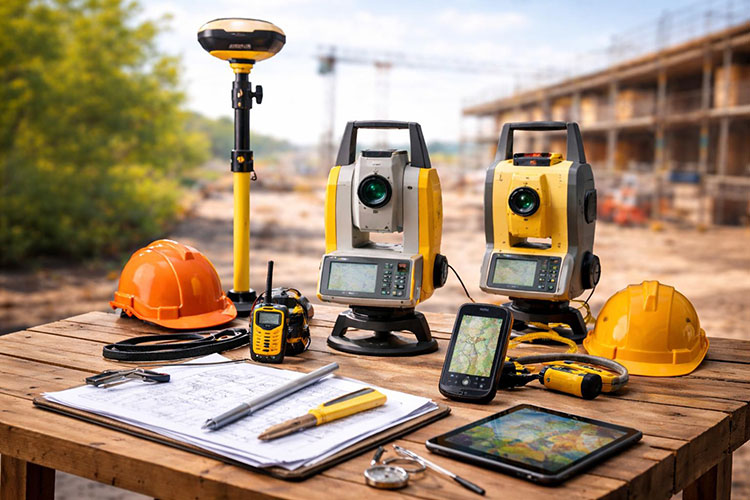
A reliable surveying setup involves more than a GNSS receiver or total station. The accessories used to support, position and protect surveying instruments can have a direct effect on field efficiency and measurement quality.
A loose tripod, incorrectly configured prism, unstable survey pole or incompatible mounting adapter can create problems even when the main instrument is functioning correctly.
For land surveyors, construction teams and surveying equipment dealers, choosing the right accessories means considering instrument compatibility, stability, working conditions and long-term maintenance.
This guide explains the essential surveying accessories used in professional fieldwork, what each one does and which details are worth checking before purchasing.
Why Surveying Accessories Matter
Surveying accessories support the measurement process in several ways.
Some provide a stable platform for an instrument. Others establish a measurable target, maintain a consistent antenna or prism height, or help transfer elevation between points.
Accessories also influence how efficiently a crew can move between stations and how reliably equipment performs under everyday field conditions.
For example, a high-quality total station cannot compensate for a tripod that shifts during observations. Similarly, a GNSS receiver mounted on a pole with an incorrectly entered height may produce a vertical positioning error despite displaying a fixed RTK solution.
The goal is not simply to buy the most expensive accessory. It is to select components that are compatible with the instrument and appropriate for the surveying task.
Surveying Prisms and Reflective Targets
Surveying prisms are widely used with total stations to provide a defined target for electronic distance measurements.
The correct prism depends on the instrument, measurement method, working distance and required accuracy.
Standard Surveying Prisms
Standard prism assemblies are commonly used for control surveys, topographic measurements and construction layout.
A typical assembly includes a reflector, holder and mounting connection.
When selecting a standard prism, check the prism constant, mounting compatibility, optical condition and suitability for the intended total station.
The prism constant used in the instrument must match the actual reflector configuration. An incorrect setting can introduce a systematic distance error.
Mini Prisms
Mini prisms provide a compact target for measurements where a full-size assembly may be inconvenient.
They can be useful for short-range construction layout, structural work and locations with limited space.
However, mini prisms should not automatically be treated as interchangeable with standard prisms. Their optical properties, prism constants and mounting arrangements may differ.
360-Degree Prisms
A 360-degree prism is designed to provide a reflector target over a wide range of horizontal viewing directions.
These prisms are often associated with robotic total station workflows, where the instrument tracks the target as the operator moves.
Compatibility matters. Different robotic total station systems may require particular reflector designs or configurations for reliable tracking and measurement.
Monitoring Prisms and Reflective Targets
Monitoring prisms can be installed at selected points to support repeated displacement observations.
Reflective targets and sheets are also used for certain total station applications where compact or fixed targets are needed.
The appropriate target depends on the instrument's measurement capabilities, observation geometry, required precision and site conditions.
For monitoring work, mounting stability and repeatable measurement procedures are especially important.
Explore the available options in our Surveying Accessories category.
Surveying Poles: Prism Poles and GNSS Rover Poles
Surveying poles hold a prism or GNSS receiver at a measurable height above a ground point.
Although they appear simple, pole construction, locking mechanisms and straightness can affect field performance.
Prism Poles
Prism poles are commonly used with total stations for topographic surveys, setting out and detail measurements.
Important considerations include:
Suitable mounting threads or adapters
A dependable locking mechanism
Clearly readable height markings
Pole straightness and tip condition
Appropriate weight and durability
A worn tip or loose telescopic section can reduce repeatability, especially when observations are taken from multiple setups.
GNSS Rover Poles
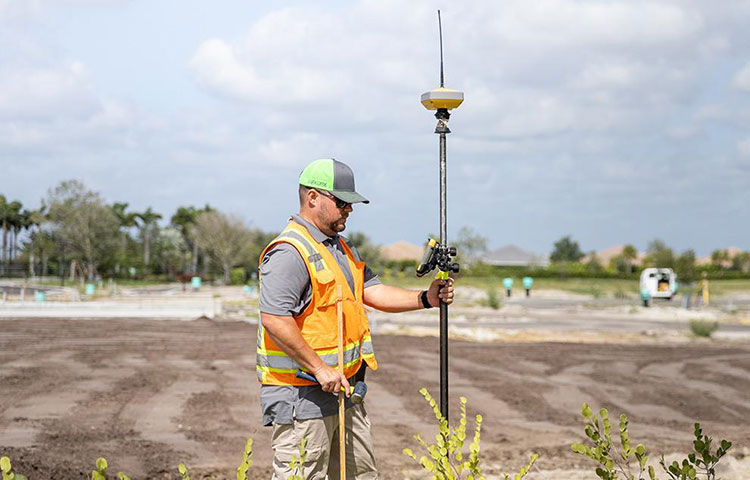
GNSS poles support receivers during RTK surveying.
Carbon-fiber and other suitable pole constructions may offer different balances of weight, stiffness and durability.
The pole should provide a stable mounting connection and a reliable method of determining antenna height.
When a receiver uses tilt compensation, the pole and mounting arrangement must still be compatible with the manufacturer's operating requirements.
Why Pole Height Is Important
The height entered into a survey controller must correspond to the correct measurement reference.
For GNSS, the software may require a specific antenna reference point or measurement method.
For prism measurements, the prism height and instrument settings must reflect the actual setup.
A consistent height-entry procedure is an important part of field quality control.
Surveying Tripods: Stability Comes First
Tripods provide the foundation for total stations, levels, GNSS base stations and other surveying instruments.
A stable tripod helps maintain the instrument's position during observations.
Wooden, Aluminum and Fiberglass Tripods
Tripod materials have different practical characteristics.
Wooden tripods are used in many precision instrument applications because of their stability and vibration-related characteristics.
Aluminum tripods are widely used where portability and convenient handling are priorities.
Fiberglass tripods are another option for demanding field environments, depending on the product design.
Material alone does not determine performance. Joint construction, leg locks, head design and overall condition are also important.
Matching a Tripod to the Instrument
Before ordering, verify:
Instrument weight and required stability
Tripod head type and mounting thread
Working height range
Leg-lock design
Ground conditions and foot type
Transport and storage requirements
A lightweight tripod may be convenient for routine work, while a more robust configuration may be preferable for heavier instruments or demanding measurement tasks.
Common Tripod Problems
Loose clamps, damaged feet and worn mounting connections can allow unwanted movement.
Crews should inspect tripods regularly and avoid continuing critical observations when the setup is unstable.
For a total station or level, the condition of the tripod is part of the measurement system—not merely a transport accessory.
Leveling Staffs for Elevation Measurements
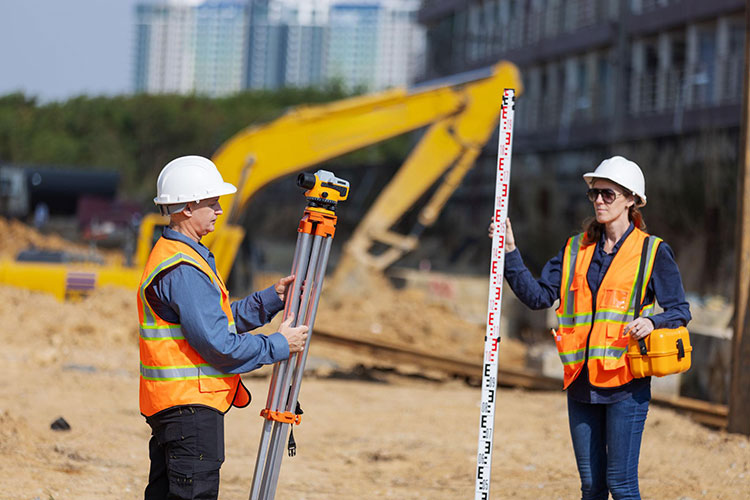
Leveling staffs are used with optical and digital levels to determine height differences between points.
They are essential accessories for construction leveling, elevation transfer and many engineering survey tasks.
Telescopic Leveling Staffs
Telescopic staffs are convenient for transport and general field use.
They are available in different lengths and materials, with designs intended for particular applications.
A suitable staff should have readable graduations, secure section locks and an appropriate base.
Invar Staffs for Precision Leveling
Invar staffs are associated with precision leveling applications where dimensional stability is particularly important.
They are not simply substitutes for ordinary construction leveling staffs.
The staff must be suitable for the level, measurement method and required accuracy.
Staff Compatibility with Digital Levels
Digital levels may require a specific bar-code staff pattern or manufacturer-compatible design.
A staff that works with one digital level system should not be assumed to work with every other model.
Always confirm compatibility before purchasing replacement staffs.
Tribrachs, Adapters and Mounting Accessories
Tribrachs and adapters connect surveying instruments or targets to supporting equipment.
They are especially important when instruments, prisms or GNSS receivers must be mounted securely and centered over a point.
Tribrachs
A tribrach provides a mounting and leveling interface for compatible instruments and accessories.
Some configurations include an optical or laser plummet, while others are intended for use with separate centering arrangements.
The required type depends on the instrument and surveying workflow.
Tribrach Adapters
Adapters help connect prisms, targets, GNSS equipment or other accessories to suitable mounts.
Check the physical connection, centering arrangement and any required height offset.
An adapter that fits mechanically is not necessarily suitable for every precision measurement task.
Diagonal Eyepieces
Diagonal eyepieces are useful in certain total station or theodolite observations where the viewing angle makes direct sighting uncomfortable.
Compatibility is model-dependent, so the instrument type should be confirmed before ordering.
Survey Data Collectors and Field Controllers
Survey data collectors allow crews to configure instruments, manage projects, record observations and perform stakeout operations.
A compatible controller can simplify workflows across GNSS and total station equipment.
However, compatibility involves more than the operating system or wireless connection.
What to Check Before Buying
Confirm the following:
Supported receiver or total station models
Compatible surveying software
Communication methods
Screen readability in outdoor conditions
Battery endurance and charging options
Environmental protection
Data export and coordinate-system support
For teams operating several instrument brands, it is important to confirm which devices and functions are actually supported by the chosen software.
Batteries, Chargers and Equipment Protection
Power and protection accessories help keep surveying equipment operational throughout the working day.
Some instruments use removable batteries, while others use integrated battery systems or external charging arrangements.
Replacement batteries and chargers must be selected according to the instrument's actual compatibility requirements.
Do not assume that two batteries are interchangeable simply because their shape or connector appears similar.
Carrying Cases and Protective Equipment
Transport cases, protective bags and suitable storage arrangements can reduce the risk of accidental damage.
Surveying prisms, optical components and precision mounting accessories should be protected from impact, contamination and unnecessary movement during transport.
Regular cleaning and inspection can also help extend their service life.
Choosing Accessories for Different Surveying Tasks
The right combination depends on the instruments and the work being performed.
GNSS RTK Land Surveying
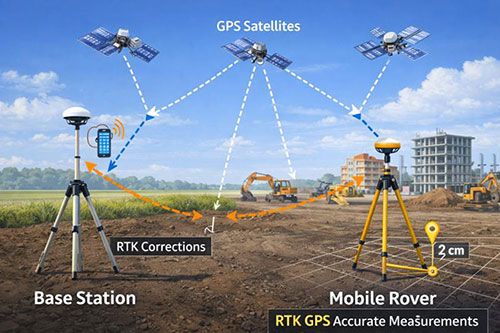
A typical GNSS rover workflow may require a suitable survey pole, controller, mounting adapters and transport protection.
A local base station setup may additionally require a tripod, appropriate mount and communication equipment.
The exact configuration depends on the receiver model and correction method.
For practical setup guidance, see our GNSS RTK Base and Rover Field Guide.
Total Station Construction Layout
A construction layout crew may need a stable tripod, compatible prism, prism pole, tribrach and controller.
If a robotic total station is used, the reflector and tracking workflow must be compatible with the instrument.
For equipment selection advice, read How to Choose a Total Station for Surveying.
Engineering Leveling
Leveling work requires a suitable level, stable tripod and compatible leveling staff.
Higher-precision applications may require specialized staffs and additional quality-control procedures.
Monitoring and Repeated Observations
Monitoring projects may require fixed prisms, stable mounts and repeatable observation geometry.
Long-term mounting stability, target identification and consistent measurement procedures are essential considerations.
A Practical Surveying Accessories Checklist
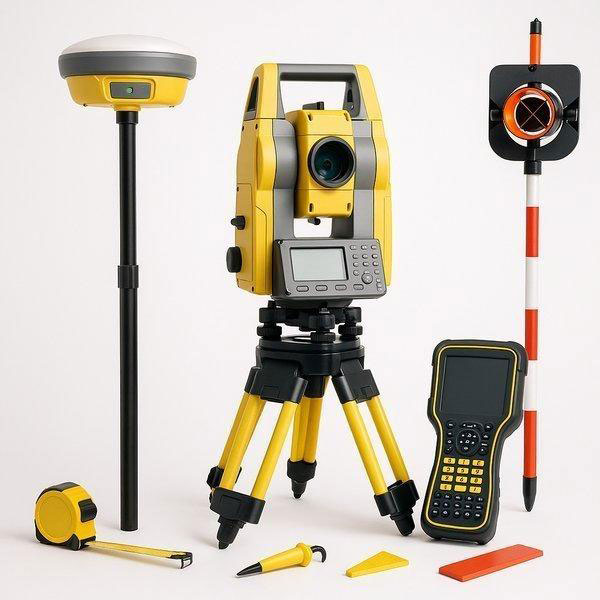
Before a crew leaves for a project, a short inspection can prevent avoidable interruptions.
Instrument and Mounting
Confirm tripod stability and mounting compatibility.
Inspect tribrachs and adapters.
Check pole locks, tips and height markings.
Verify prism mounts and reflector condition.
Measurement Configuration
Confirm the correct prism constant.
Verify antenna or prism height settings.
Check controller and instrument compatibility.
Prepare the required coordinate-system information.
Power and Protection
Charge the equipment using compatible chargers.
Check available batteries and cables.
Inspect transport cases.
Pack suitable cleaning and protective materials.
On-Site Verification
Check the instrument setup before observations.
Confirm accessory stability.
Observe appropriate control points.
Investigate unexpected differences before continuing production work.
This checklist should be adapted to the project's accuracy requirements and established survey procedures.
What Surveying Equipment Dealers Should Consider
For surveying equipment distributors and procurement teams, accessories can be an important part of a complete equipment package.
A GNSS receiver or total station may require several supporting components before it is ready for field operation.
When purchasing accessories for resale or project supply, consider product compatibility, available configurations, replacement requirements and the types of instruments used by your customers.
It is also useful to clarify whether customers need complete assemblies or individual replacement components.
For example, a request for a surveying prism may refer to a reflector alone, a prism with holder, or a complete assembly with target and mounting accessories.
Clear specifications help avoid ordering errors and unnecessary delays.
Explore Surveying Accessories at RTKSurvey.com
RTKSurvey.com supplies surveying accessories for professional land surveying, construction and engineering applications.
Our product range includes surveying prisms, prism and GNSS poles, tripods, leveling staffs, tribrach adapters, survey data collectors and other supporting equipment.
Visit our Surveying Accessories category to explore the available product types.
If you are selecting equipment for a specific receiver or total station, contact RTKSurvey.com with the instrument model and required accessory configuration so compatibility can be checked before ordering.
Frequently Asked Questions
What Are the Most Important Surveying Accessories?
Common essentials include tripods, prisms, survey poles, leveling staffs, tribrachs, adapters and field controllers. The actual requirements depend on whether the crew uses GNSS receivers, total stations or levels.
Are All Surveying Prisms Compatible with Every Total Station?
No. Prism constants, reflector designs and tracking requirements can differ. Compatibility and instrument settings should be verified before use.
What Is the Difference Between a Prism Pole and a GNSS Pole?
A prism pole supports a reflector used with a total station, while a GNSS pole supports a satellite positioning receiver. Some mounting arrangements may be adaptable, but connection types, height conventions and operational requirements must be checked.
Can I Use Any Tripod with a Total Station?
Not necessarily. The tripod must provide suitable stability, mounting compatibility and working height for the instrument.
Do Digital Levels Require Special Leveling Staffs?
Many digital levels use compatible bar-code staffs. The correct pattern and staff type depend on the level model and measurement requirements.
Why Are Tribrachs Important in Surveying?
Tribrachs provide a mounting and leveling interface. A suitable, well-maintained tribrach helps support stable instrument or target positioning during measurements.
Final Thoughts
Surveying accessories play an important role in measurement quality, equipment compatibility and field productivity.
Selecting the right prism, pole, tripod, leveling staff or mounting adapter requires more than matching a product name. Surveyors and procurement teams should consider the intended application, instrument compatibility, working conditions and required accuracy.
A carefully selected set of accessories can make field operations more efficient while reducing avoidable setup problems and measurement errors.