Welcome to RTKSurvey.com

Total Station Resection vs Backsight: Setup Accuracy and Field Checks
A total station can measure angles and distances precisely, but those measurements are only useful when the instrument's position and orientation are correctly established.
On a construction site, surveyors commonly use two approaches: setting up over a known control point and orienting to a backsight, or using resection to calculate the instrument position from observations to known points.
Both methods can produce reliable results. Both can also introduce systematic errors when control coordinates, target settings or observation geometry are wrong.
This guide compares total station resection and backsight setup, explains their practical limitations, and shows how to verify the results before beginning construction layout.
Quick Answer: Resection vs Backsight
A conventional backsight setup uses a known instrument position and an observation to establish orientation. Resection calculates the instrument position and orientation from observations to known control points.
A backsight setup is straightforward when a suitable control point is accessible and provides good visibility.
Resection is useful when the instrument must occupy an unmarked location, such as a convenient position inside a busy construction site.
Neither method is automatically more accurate. The result depends on control quality, observation geometry, instrument setup and independent verification.
1. What Is a Total Station Backsight Setup?
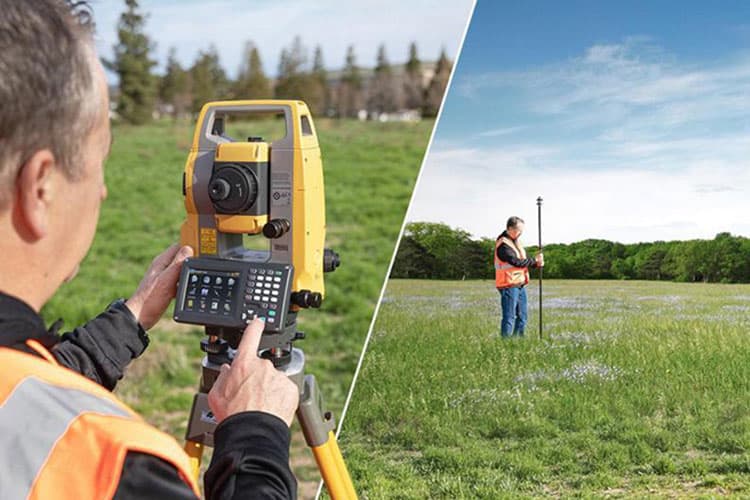
In a conventional station setup, the total station occupies a point with known coordinates.
The surveyor centers and levels the instrument, enters the station coordinates and instrument height, then observes a backsight to establish horizontal orientation.
If the backsight also has known coordinates, the software can calculate the direction between the two control points.
Example: Building Foundation Layout
A survey crew has two established control marks outside a planned building.
The total station is set up over Control Point A and oriented toward Control Point B.
Once the setup is checked, the crew can stake out foundation corners and building grid positions.
This approach is convenient because the instrument position is already defined by the control network.
However, the setup can still be wrong if the instrument is centered over the wrong mark, the backsight is misidentified or the entered coordinates are incorrect.
A Backsight Is Not an Independent Accuracy Check
Observing a single backsight establishes orientation, but it does not independently confirm every aspect of the setup.
For important work, observe an additional known control point that was not used solely to establish the orientation.
Compare its measured coordinates or appropriate observation differences with the accepted reference values.
2. What Is Total Station Resection?
Resection is a station setup method that determines the total station's position by observing known control points.
It is also commonly associated with the term free station setup.
Instead of placing the instrument directly over a surveyed control mark, the operator chooses a suitable location and measures angles, distances or both to known points.
The field software uses these observations and the control coordinates to calculate the instrument position and orientation.
How Many Control Points Are Required?
The minimum depends on the measurement types, geometry and software.
For example, Trimble Access supports resection using either:
Two observations containing angles and distances to different known points.
Three angle-only observations to different known points.
These are software-specific minimum configurations, not a recommendation that the minimum number of points is sufficient for every precision survey.
Using additional well-distributed control points generally provides better opportunities to detect inconsistent observations.
Example: A Crowded Construction Site
Imagine a building site where the original control marks are located beside fences and temporary structures.
Setting up directly over one control mark would obstruct vehicle access and provide poor visibility of the work area.
The surveyor instead chooses a stable position with clear sightlines to several established control points.
A resection calculates the station coordinates and orientation, allowing the crew to continue layout without occupying a control mark.
Before accepting the setup, the surveyor reviews the observation residuals and measures an independent check point.
3. Total Station Resection vs Backsight: Key Differences
| Factor | Known-Point Backsight Setup | Resection / Free Station |
|---|---|---|
| Instrument location | Known control point | Convenient unknown position |
| Station coordinates | Entered from control | Calculated from observations |
| Orientation | Established from backsight | Calculated using control observations |
| Control requirements | Known occupied point and suitable orientation reference | Multiple known observed points |
| Main advantage | Straightforward, established control | Flexible instrument placement |
| Main risk | Incorrect occupied point or orientation | Weak geometry or unsuitable control |
| Quality control | Additional control observations | Residual review plus independent checks |
| Typical application | Building grids and conventional traverse work | Congested sites and obstructed control locations |
The better method is the one that satisfies the project's accuracy requirements with reliable control and suitable observation geometry.
4. Why Resection Geometry Matters
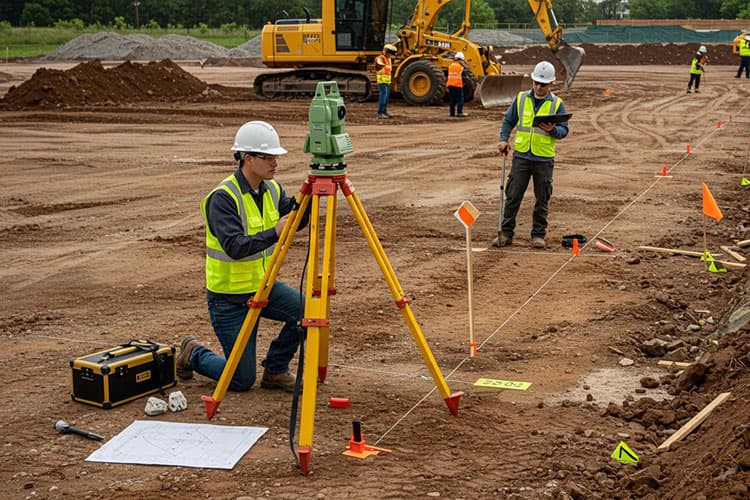
Resection accuracy depends on more than the number of control points.
The spatial arrangement of those points affects how reliably the instrument position can be determined.
Poor Geometry
Suppose three control targets are located close together along one side of a construction site.
Although the software may calculate a station position, the observations may provide weak geometric constraints in certain directions.
Small observation errors can then produce larger uncertainty in the calculated station coordinates.
Better Geometry
Now consider control points distributed across different directions around the instrument.
The observations provide a more balanced geometric configuration.
This can improve the stability of the solution and make some inconsistencies easier to detect.
However, a point should not be included merely to increase the number of observations. Its coordinates, stability and visibility must also be reliable.
Practical rule: Favor stable, well-distributed control with suitable intersection geometry. Do not judge a resection solely by the number of points observed.
5. Understanding Resection Residuals
After calculating a resection, field software may display residuals for the observations.
Residuals indicate differences between the observed information and the values predicted by the adjusted station solution.
They are useful for identifying inconsistent control points or observations.
But low residuals do not guarantee that the station coordinates are correct.
Example: Small Residuals, Wrong Control
Consider a hypothetical resection using three control points.
The field software reports small residuals and the station solution appears acceptable.
However, all three control coordinates came from the same incorrectly transformed project file.
The observations may agree closely with one another while the calculated station remains inconsistent with the correct project reference.
This illustrates the difference between internal consistency and external accuracy.
What to Review Before Accepting the Setup
Check:
Control point identification and coordinate source.
Horizontal and vertical residuals, where applicable.
Observation geometry and distance distribution.
Instrument and target height settings.
Prism constant and target type.
Any warning about multiple or poorly constrained solutions.
Agreement with independent project control.
If one observation has a large residual, investigate the cause before excluding it.
Removing an observation simply to make the residual report look better can conceal an underlying problem.
6. Five Common Total Station Setup Errors
1. Incorrect Backsight Point
The operator aims at one control mark but selects another point name in the controller.
This can produce an incorrect orientation and affect subsequent stakeout.
Verify point identification before storing the setup.
2. Wrong Prism Constant
A target profile from a previous job may remain active after the crew changes prisms.
This can introduce systematic distance errors.
For more information, see Total Station Prism Constant Explained.
3. Incorrect Instrument or Target Height
Wrong height entries can affect calculated elevations.
Check the actual measurement reference and mounting arrangement rather than assuming every target uses the same height convention.
4. Poor Resection Geometry
Several observations concentrated in a narrow direction may provide an unreliable station solution.
Where possible, improve the distribution of observed control points.
5. No Independent Check
A station setup may appear successful on the controller while still containing a significant error.
Before staking critical points, measure suitable independent control and compare the result with the project's tolerance.
7. Field Procedure: How to Verify a Total Station Setup
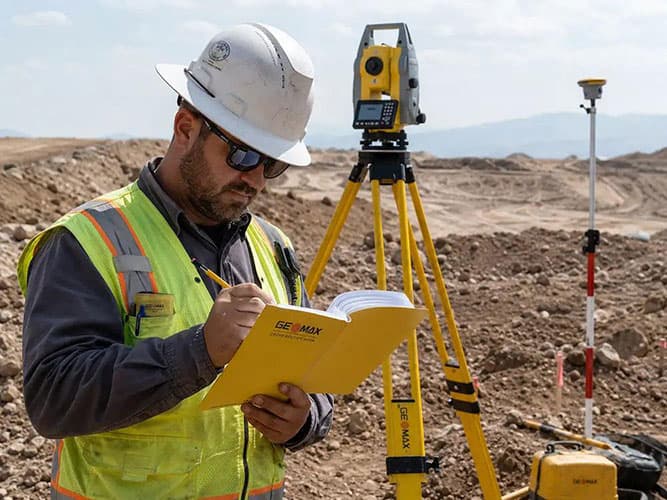
The following workflow can be adapted to a known-point backsight setup or a resection.
Step 1: Verify Project Control
Confirm that the control coordinates correspond to the approved project reference system.
Check point identification, physical stability and the required coordinate units.
Step 2: Check the Instrument
Center and level the total station appropriately.
Verify instrument height, environmental corrections and the measurement settings required by the project.
Step 3: Configure the Target
Select the correct prism type, prism constant and target height.
For robotic instruments, also confirm the tracking target and measurement mode.
Step 4: Complete the Setup
For a known-point setup, enter the correct station coordinates and establish orientation using the backsight.
For resection, observe suitable known control points and review the calculated station result.
Step 5: Observe Independent Control
Measure a known point that provides a meaningful independent check of the setup.
Where possible, use a point not included in the resection calculation.
Step 6: Compare Against Project Tolerances
Review the horizontal and vertical differences, where relevant.
A difference that is acceptable for general topographic work may be unacceptable for structural layout.
Use the approved survey specification rather than a universal numerical threshold.
Step 7: Record the Setup
Document the occupied or calculated station coordinates, control observations, target settings, check results and any corrective action.
This provides a useful audit trail if a layout discrepancy is discovered later.
8. Which Setup Is Better for Construction Layout?
For building foundations and structural work, both methods can be appropriate when properly controlled.
A known-point backsight setup may be preferable when stable control marks are accessible and the survey crew can establish a suitable orientation.
Resection can be more efficient when the work area changes frequently or the instrument needs to be positioned away from existing control marks.
For projects with demanding tolerances, the setup method should be selected in conjunction with the control survey design and quality-control procedure.
A reliable total station is important, but correct setup and independent checking are equally essential.
If you are evaluating equipment for construction work, see our Total Stations category and How to Choose a Total Station guide.
9. What to Look for When Buying a Total Station
Contractors who regularly use resection and backsight workflows should evaluate more than nominal angle accuracy.
Useful features include:
Flexible station setup and resection functions.
Support for multiple control observations.
Clear residual and setup result reporting.
Reliable prism and reflectorless measurement modes.
Convenient data import and coordinate management.
Field software that supports independent check observations.
Suitable battery life and environmental protection for the job.
Specific capabilities vary by model and software version.
RTKSurvey.com supplies multiple brands of surveying instruments, allowing buyers to compare Total Stations for construction, engineering and general surveying applications.
Frequently Asked Questions
Is resection more accurate than a backsight setup?
Not necessarily. Accuracy depends on control quality, observation geometry, instrument performance and verification procedures. Neither method is universally superior.
Can I perform a resection with only two points?
Some total station software supports two-point resection when suitable angle and distance observations are available. The minimum requirements depend on the instrument and software. Additional observations may improve reliability and error detection.
Why does my resection show large residuals?
Possible causes include incorrect control coordinates, poor target identification, measurement errors, unsuitable geometry or incorrect target settings. Investigate the cause before accepting the solution.
What is the difference between resection and free station?
The terms are often used together. Both generally refer to determining an instrument station from observations to known control rather than occupying a known station point. Exact software terminology can vary.
Should I check a total station backsight during the day?
Yes. Check the setup at appropriate intervals and after events that could affect the instrument position or orientation. Follow the project's survey quality-control requirements.
Final Thoughts
A reliable total station setup is the foundation of accurate construction layout.
A known-point backsight setup offers a straightforward workflow when suitable control is available. Resection provides greater flexibility when the instrument must occupy an unknown position.
Whichever method is used, the surveyor should verify the control, review the setup results and check critical measurements independently.
For equipment selection, explore Total Stations at RTKSurvey.com or contact our team with your project requirements.