Welcome to RTKSurvey.com

How to Choose a Surveying Prism for a Total Station
A surveying prism may be a small part of a total station setup, but choosing the wrong one can affect measurement reliability, field efficiency and compatibility.
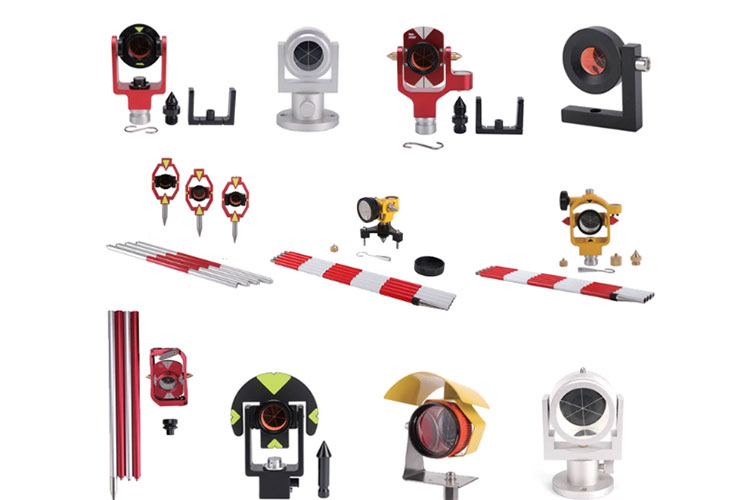
A standard prism may be suitable for everyday topographic surveying, while a mini prism can be more convenient in confined spaces. Robotic total station users may prefer a 360-degree prism, and monitoring projects often require specialized reflectors and stable mounting arrangements.

The right choice depends on the instrument, measurement distance, required accuracy and working environment.
This guide explains the main surveying prism types and what buyers should check before ordering.
1. What Does a Surveying Prism Do?
A surveying prism reflects the electronic distance measurement (EDM) signal transmitted by a compatible total station.
The instrument measures the returned signal to determine distance. Combined with horizontal and vertical angle observations, this allows the total station to calculate survey point coordinates.
Prism-based measurement can be useful when working over longer distances or when reflectorless measurement is less suitable for the target surface.
However, not every prism is interchangeable. Prism constant settings, mounting systems and instrument compatibility must be considered.
2. Main Types of Surveying Prisms
Standard Surveying Prisms
Standard circular prisms are widely used for land surveying, construction layout and control measurements.
They are commonly mounted in a prism holder or target assembly on a survey pole or tripod.
Their main advantages include established field workflows, broad availability and configurations suitable for many conventional total stations.
A standard prism is often a practical starting point for general surveying teams.
Mini Prisms
Mini prisms use smaller reflector assemblies and are often selected for compact or difficult-to-access locations.
They can be useful for:
Construction layout in confined spaces
Short-range detail measurements
Measurements around structural components
Applications requiring a compact target assembly
However, a mini prism should not automatically be treated as having the same working range as a larger prism.
The effective measurement range depends on the prism design, total station EDM and field conditions.
360-Degree Prisms
A 360-degree prism assembly is designed to return EDM signals from multiple horizontal directions.
These prisms are particularly useful with robotic total stations because the operator can move around the instrument without continuously rotating a conventional single-face prism toward it.
Different 360-degree prism designs may have different tracking characteristics and accuracy specifications.
When purchasing, confirm compatibility with the intended robotic total station and tracking workflow.
Monitoring Prisms
Monitoring prisms are used for repeated observations of structures, slopes, tunnels and other monitored objects.
They are often installed on fixed brackets or mounts rather than carried on survey poles.
For monitoring work, the long-term stability of the reflector and mounting arrangement is especially important.
A suitable prism should be selected according to the monitoring distance, instrument capability, environmental exposure and required measurement precision.
Reflective Targets
Reflective survey targets provide a lightweight alternative for certain short-range measurements.
They may be useful where installing a conventional prism assembly is impractical.
However, reflective targets are not equivalent to glass prisms in every application. Their usable distance and measurement characteristics depend on the total station and target specification.
3. Surveying Prism Types Compared
| Prism Type | Common Application | Main Buying Consideration |
|---|---|---|
| Standard prism | General surveying and construction | Prism constant, holder and mounting |
| Mini prism | Confined spaces and detail work | Working range and compact design |
| 360-degree prism | Robotic total station surveying | Tracking compatibility and accuracy |
| Monitoring prism | Structural and deformation monitoring | Mounting stability and durability |
| Reflective target | Selected short-range measurements | EDM compatibility and usable range |
No single prism type is best for every survey.
The correct choice depends on how the reflector will be used and what the total station manufacturer supports.
4. Why Is the Prism Constant Important?
The prism constant is a correction associated with the reflector's optical geometry and the distance measurement system.
Different prism designs can require different constant settings.
If the total station is configured with an incorrect prism constant, a systematic distance error can result.
For example, using a reflector that requires one correction while the instrument is configured for another can shift measured distances by a consistent amount.
Prism constants are not universally interchangeable between manufacturers or instrument systems.
Some brands use different reference conventions when describing prism offsets or constants.
Before fieldwork, confirm the required setting from the prism and total station documentation.
For a more detailed explanation, see our Total Station Prism Compatibility Guide.
5. How to Match a Prism to Your Total Station
Before ordering a replacement or additional prism, verify the complete measurement setup.
Check the Prism Constant
Confirm the correction value and the convention used by the instrument.
Do not assume that a prism advertised as compatible with a particular brand automatically uses the same constant as every original accessory from that brand.
Confirm the Mounting System
Check the prism holder, target assembly, mounting thread and connection to the pole or tribrach.
The reflector may fit the instrument's EDM requirements but still need a different mounting adapter.
Consider the Measurement Distance
A prism intended for short-range construction work may not be appropriate for long-distance control measurements.
Compare the reflector specifications with the total station's supported measurement modes and ranges.
Check Robotic Tracking Requirements
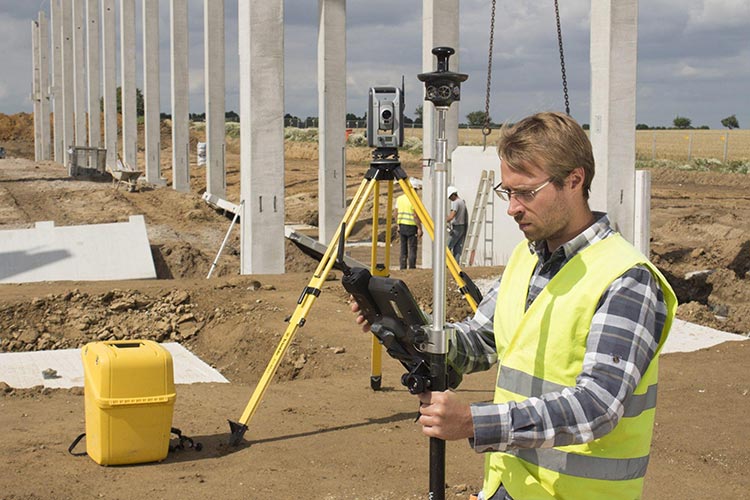
If using a robotic total station, verify that the prism assembly is suitable for the instrument's automatic target recognition or tracking system.
A generic 360-degree reflector should not be assumed to provide identical tracking performance to a manufacturer-specific prism.
6. Which Prism Should You Choose for Different Projects?
General Land Surveying
For conventional topographic measurements and control points, a standard circular prism with the correct constant and suitable mounting accessories is often a practical choice.
Construction Layout
For routine stakeout, standard prisms are widely used.
Mini prisms can be useful where access is restricted or a compact target is required.
Robotic Surveying
A compatible 360-degree prism may improve workflow efficiency by allowing the operator to move around the instrument with less manual prism orientation.
Deformation Monitoring
Choose a reflector and mounting system designed for stable, repeatable observations.
For long-term monitoring, consider weather exposure, mounting security and the overall measurement methodology.
7. Common Mistakes When Buying Surveying Prisms
Choosing only by price. A low-cost reflector may not be suitable for a demanding measurement application.
Ignoring the prism constant. An incorrect instrument setting can introduce systematic distance errors.
Assuming all 360-degree prisms are interchangeable. Robotic tracking compatibility and measurement performance vary.
Overlooking accessories. A complete setup may require a prism holder, target plate, pole adapter, tribrach or mounting bracket.
Confusing reflective targets with conventional prisms. Their performance and measurement range may differ significantly.
For more information about supporting equipment, read our Essential Surveying Accessories Guide.
8. What Should Distributors and Bulk Buyers Check?
For surveying equipment distributors and project procurement teams, consistency across an order can be as important as individual product specifications.
Before placing a bulk order, confirm:
Prism type and intended total station compatibility
Prism constant and reference convention
Reflector dimensions and assembly configuration
Included holders, targets and mounting accessories
Packaging and spare-part availability
Required quantity and destination country
If purchasing prisms for several total station brands, prepare a compatibility list rather than assuming one reflector configuration will suit every instrument.
Frequently Asked Questions
What Is the Difference Between a Standard Prism and a Mini Prism?
A standard prism generally uses a larger reflector assembly, while a mini prism offers a more compact configuration. Their measurement ranges and applications depend on the specific models.
Can I Use Any Prism With My Total Station?
Not necessarily. Confirm the prism constant, EDM compatibility, mounting arrangement and any robotic tracking requirements.
Are 360-Degree Prisms More Accurate?
Not automatically. Their main advantage is multi-directional signal return for robotic workflows. Accuracy depends on the prism design, instrument and measurement conditions.
What Happens If the Prism Constant Is Wrong?
An incorrect setting can introduce a systematic distance measurement error. Always verify the appropriate correction before collecting important survey data.
Are Monitoring Prisms Different From Standard Prisms?
Monitoring prisms are often selected for fixed installation and repeatable long-term observations. Their mounting stability and environmental suitability are important considerations.
Find Surveying Prisms for Your Equipment
Choosing a surveying prism is not simply a matter of selecting the largest reflector or the lowest price.
A suitable prism should match the total station, measurement distance, accuracy requirements and field workflow.
RTKSurvey.com supplies multiple types of surveying prisms, including standard, mini, 360-degree, monitoring and compatible reflector assemblies.
Explore our Surveying Prisms category to compare available options.
If you are sourcing prisms for a surveying company, construction project or equipment distribution business, contact RTKSurvey.com with your total station model, required prism type, quantity and destination country to discuss suitable configurations.